

The Haili Story (Part II): Breaking Through and Reborn—Setting Sail Again After the Storm...
How much weight can a single rope bear?
How many legends can a century-old factory continue to write?
Across the nation, manufacturing enterprises with a history of over one hundred years account for less than one-thousandth of the total;
in Shandong Province, such century-old manufacturers are few and far between.
Yet in Qingdao, there stands one such enterprise—
a company that has traversed a century of time, all by means of a single rope.
That enterprise is Haili.
A century of craftsmanship, an unwavering original intent;
a legacy passed down through generations, building a strong nation through industry.
The “Haili Story”series of posts continues to unfold. In our previous installment, we witnessed the rise and eventual curtain-call of the Xiecheng Lace Factory—a journey that began with a simple red hair-tie and culminated in its status as the "Premier Factory North of the Yangtze."
In this installment, we press onward. Guided by the voice of veteran employee Xing Jianhua, we observe how dormant machinery was brought back to life. We watch as this very rope—a vessel for industrial dreams—navigates the tides of the era, shouldering the glory of both family and nation, and bursting forth with renewed vitality.
IV: The Rebirth of the Lace Factory
Let us turn back the clock to June 2, 1949—the day Qingdao was liberated. Outside, gongs and drums thundered in celebration as people rushed through the streets, spreading the joyous news. Yet, amidst this jubilation, the Xiecheng Lace Factory remained a silent, dormant entity—its gates tightly locked, its machinery gathering dust.
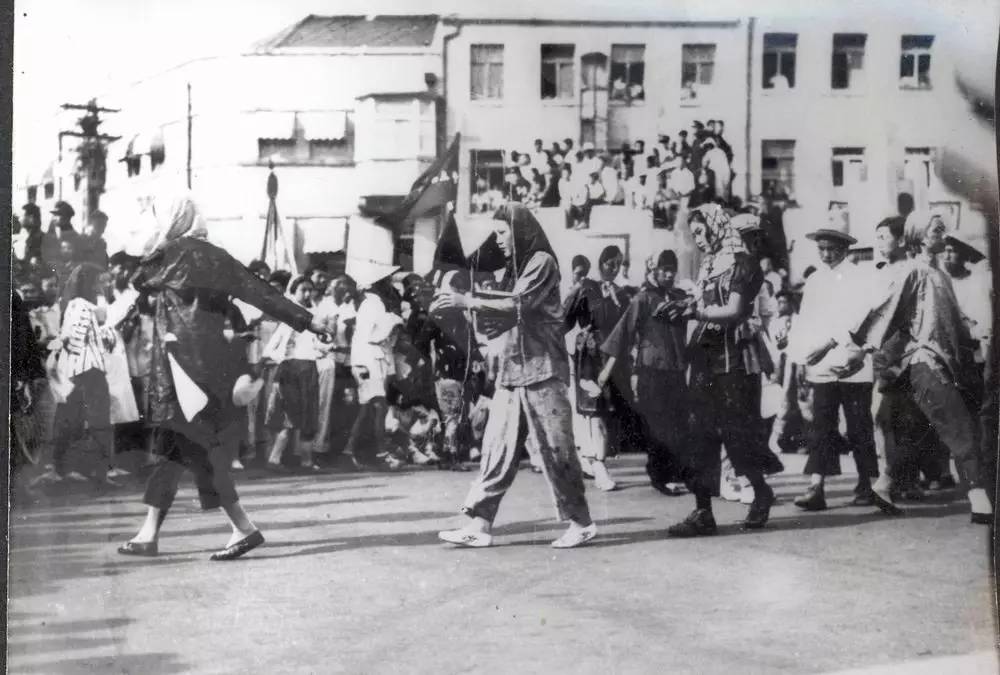
Qingdao citizens celebrating the city's liberation (Image source: *Qingdao Daily*)
During those days, although the factory building still stood, it remained unable to resume operations due to a severe shortage of both capital and raw materials. It was at this critical juncture that the factory's proprietor, Song Yunju, took the initiative to answer the call to action; leading the mere eight remaining workers, he took the first decisive step toward breaking the deadlock.
The 1952 Qingdao Commodity Trade Fair proved to be Xiecheng's "lifeline"—a golden opportunity for salvation. Song Yunju poured every ounce of his energy into securing the most prime exhibition booth available, while the workers, for their part, signed a solemn pledge—a "vow of life and death"—committing themselves to the cause with absolute devotion. From dawn until deep into the night, they toiled tirelessly—forgetting to eat or sleep—until, by the time the event concluded, their entire backlog of unsold inventory had been nearly completely sold out. Those heavy stacks of payment funds not only saved the factory from ruin but also drove home a crucial lesson to everyone: as long as you are willing to work, there is always hope!
Just as the financial crisis was resolved, a shortage of raw materials—particularly rubber filament—emerged as the next pressing challenge. With a complete shutdown looming, Song Yunju felt the urgency more acutely than anyone else. After much deliberation, he finally devised a practical and effective solution: meticulously cutting discarded automobile inner tubes into thin strips to serve as a substitute for the original rubber cords. It was this simple yet ingenious improvisation that allowed production—which had ground to a halt—to resume its smooth, steady course.
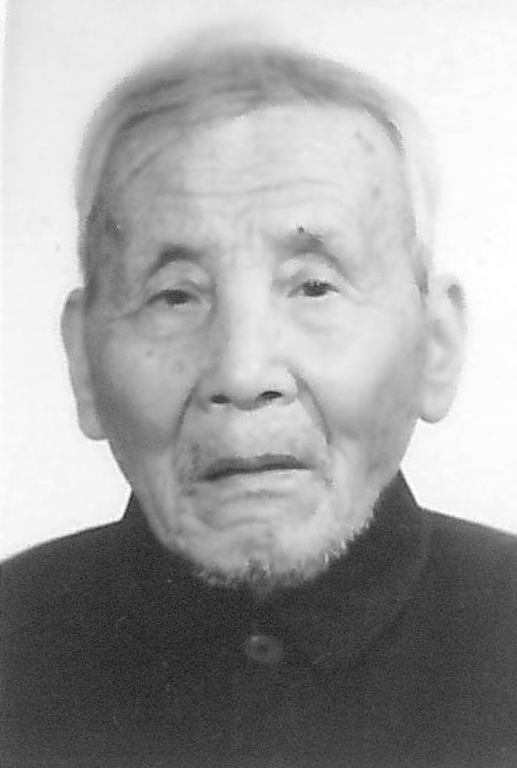
Song Yunju
In January 1953, amidst a swirling snowfall, the machinery at Xiecheng Lace Factory began to turn once again. That long-absent roar served as the most moving declaration of rebirth in the aftermath of war. That very year, the lace factory achieved impressive results, generating an output value of 100,000 yuan and a profit of 40,000 yuan. This venerable old factory, having weathered so many hardships, had finally been infused with renewed vitality and vigor.
Over the decades that followed, Xiecheng continued to advance steadily, riding the waves of the changing times.
In 1956, the "spring breeze" of public-private joint ownership swept through the workshops. Brand-new equipment poured into the factory in a steady stream, and new products were continuously developed. Production output soared, and the factory entered a genuine "golden age" of growth.
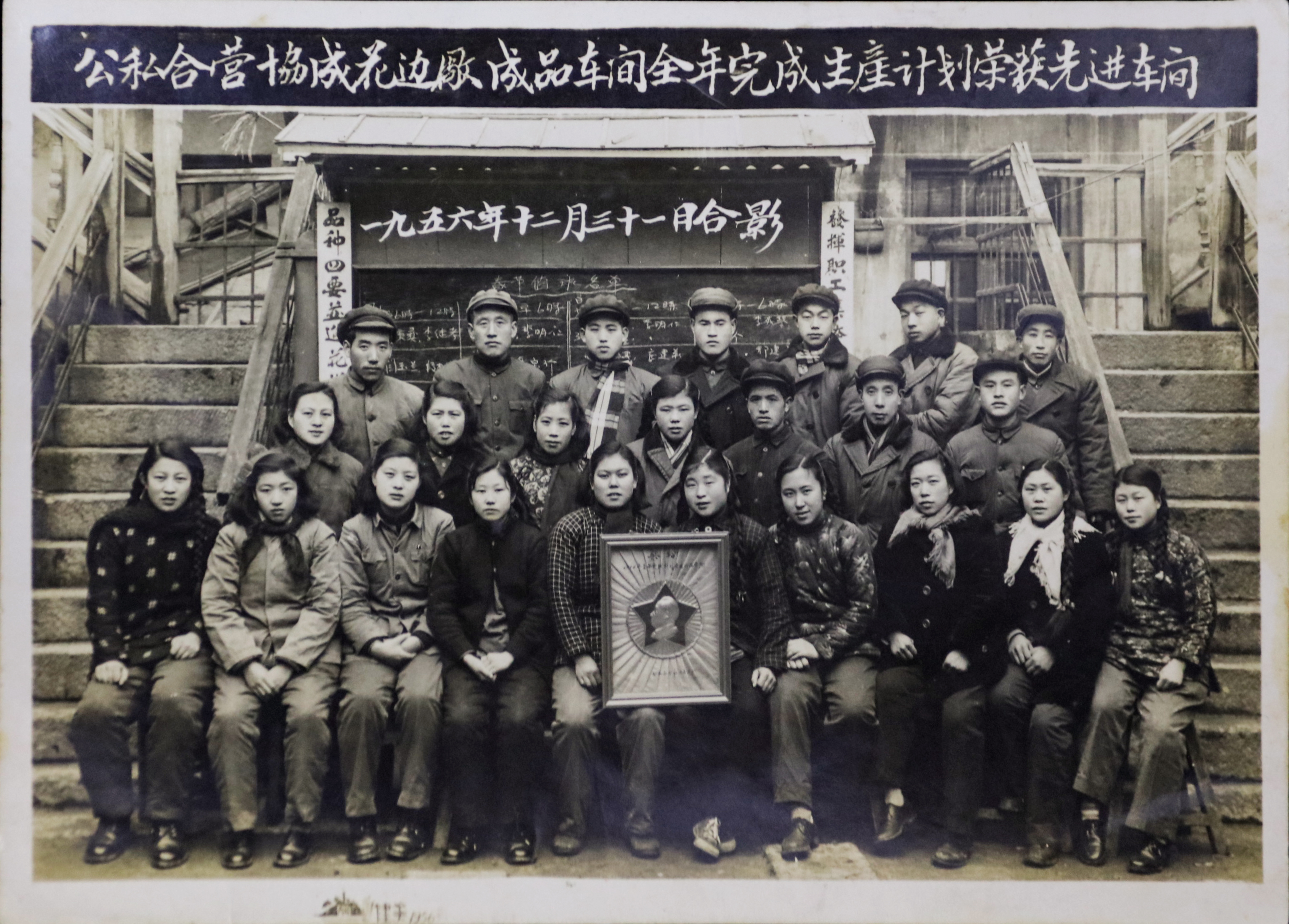
December 31, 1956: The finished products workshop at the public-private joint-venture Xiecheng Lace Factory. Having successfully completed its annual production plan, the workshop was honored with the title of "Advanced Workshop."
In 1957, veteran Party member Sun Qinben assumed the role of Party Branch Secretary. She moved her office directly onto the workshop floor, where her rigorous and pragmatic leadership style ignited a wave of enthusiastic productivity throughout the entire factory. In those days, every corner of the workshop was filled to the brim with sheer drive, hope, and the vibrant, roaring energy of industry.
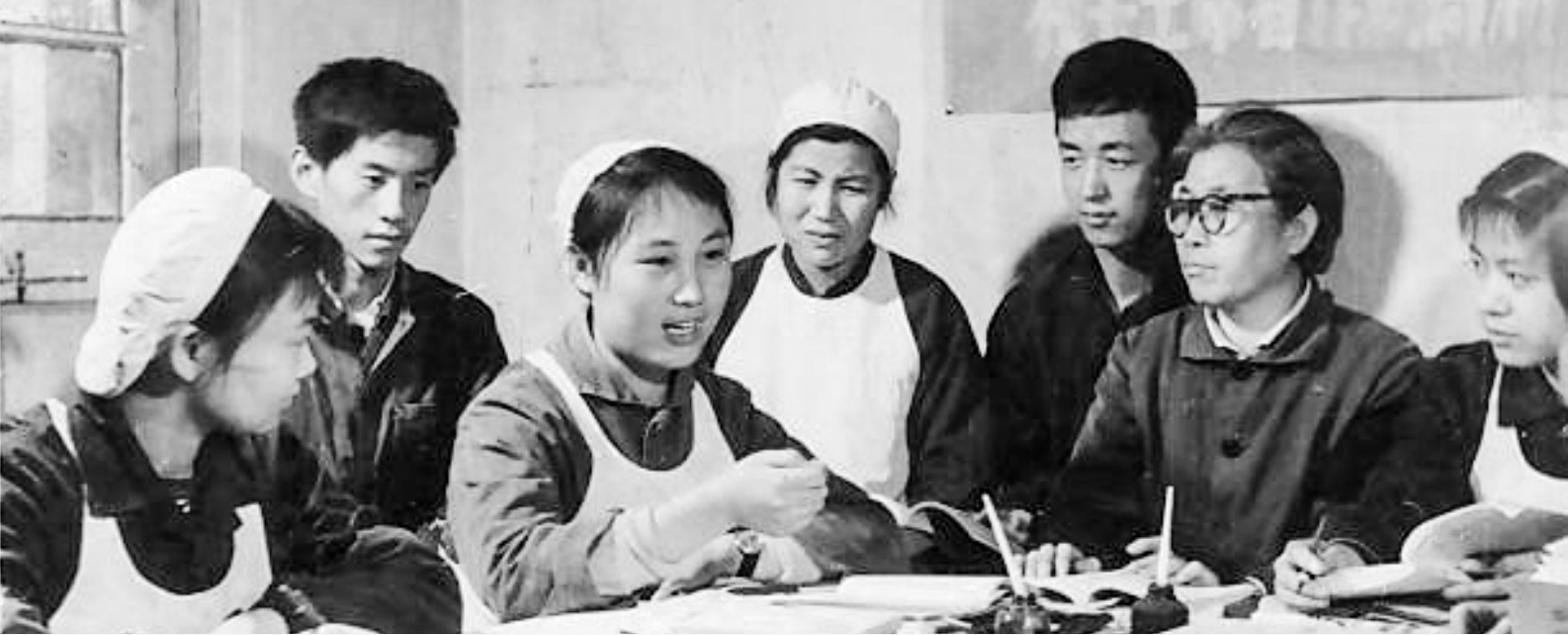
1970s: Sun Qinben (second from right)—then Secretary of the state-owned Dongfanghong Weaving Factory—leads a discussion on improving product quality with fellow staff members, including Workshop Secretary Sun Guiqin (third from left) and Workshop Director Xing Jianhua (fourth from left).
By 1964, brand-new factory buildings had risen from the ground, and the facility's equipment had undergone a comprehensive upgrade. The lace factory finally succeeded in completely shedding its reliance on products from other regions, establishing a firm foothold in the market through the sheer strength of its solid craftsmanship.
Even during the turbulent years of the Cultural Revolution—a time when the outside world was in constant flux—the factory’s employees remained steadfast in their original mission. Undeterred by external disruptions, they persevered in their production efforts amidst the hardships. The roar of machinery in the workshops never ceased; it was the stubborn, unyielding heartbeat of the old factory—and the most resolute testament to the dedication of those committed to industrial enterprise.
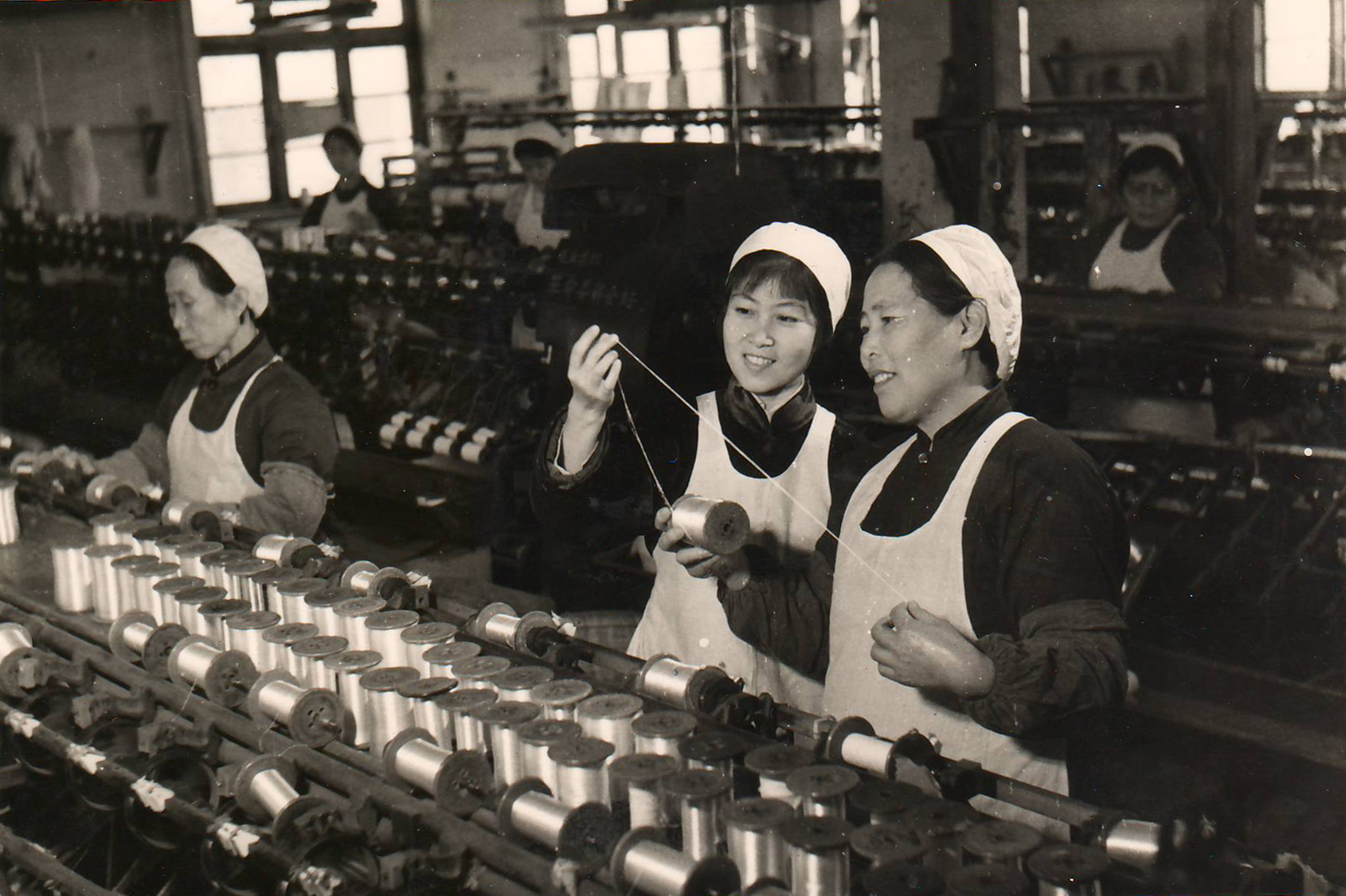
A production scene inside the workshop of the State-owned Qingdao Lace Factory, 1970s.
In 1976, with the "correction of errors" and the return of a revitalizing breeze, the factory underwent a comprehensive reorganization and was infused with renewed vitality. In October 1977, a brand-new signboard was hoisted once again: "State-owned Qingdao Lace Factory." Having weathered countless storms and endured numerous ups and downs, the venerable factory finally emerged from the mists of uncertainty to embrace a true spring of development—one that was uniquely its own.
It was precisely at this moment, brimming with hope, that a special and prestigious national assignment quietly settled upon the shoulders of the State-owned Qingdao Lace Factory...
What kind of weighty responsibility fell upon the shoulders of this factory,
which had already witnessed so much of history’s vicissitudes?
What rigorous standards and unwavering dedication lay hidden behind this glorious mission?
What spirit of artisanal craftsmanship and what glories of the era were borne witness to during this profound chapter of the past?
In our next installment, we will continue our journey into the history of the Qingdao Lace Factory to uncover the story behind that illustrious mission.
Please stay tuned for the next episode of "The haili Story!"